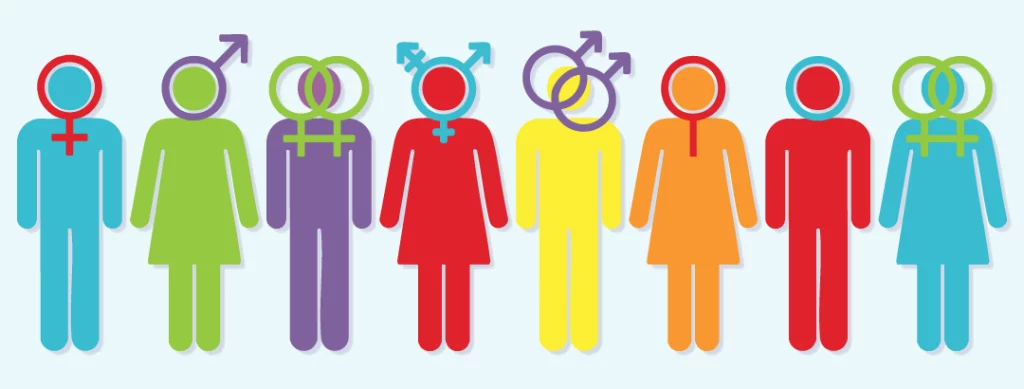
We see and hear a lot about the binaries of gender, with harmful oversimplification of the issue. This LGBT+ History Month, Archie, member of the Somerset Youth Parliament advisory group, presents a well researched and thoughtful article on the subject.
Every year in February, in the United Kingdom, LGBT+ History Month provides a time for reflection about the lives, experiences, and contributions of people who are part of the LGBTQIA+ community. This year’s LGBT+ History Month has the theme “Science and Innovation”, it is important to think about the intersection of science and social identity. The area where science is commonly misunderstood, misrepresented, or oversimplified is biological sex. The reality is that these misunderstandings impact the lives of millions of people and influence public opinion, policy-making, and healthcare.
In terms of biological sex, being either male or female is seen as something simple and binary, linked to being born one gender or the other. Many people remember being told in school that biological sex differences are due solely to chromosome differences: XX chromosomes for females, XY chromosomes for males. However, even though this model is clear and easily taught, it is very simplistic. Advances in biological and medical sciences have shown that differences in biological sex are, in fact, much more complex, and not necessarily simple or binary.
Defining biological sex
Biological sex includes the biological attributes of sex. These include, but are not limited to: chromosomes, hormonal profiles, gonads (a person’s ovaries or testes), internal reproductive anatomy, external genitalia, as well as secondary sex characteristics – which emerge at puberty – such as body hair distribution, breast development and voice pitch.
These attributes are often lumped together under the headings of “male” and “female.” For most people, these characteristics define whether a person is one or the other. Biology is not about absolutes, though and lots of people are born with variations that do not fit neatly into either category.
Importantly, biological sex is distinct from gender identity, which refers to a person’s inner sense of self as a man, as a woman, as both, as neither or as something else. While biological sex and gender identity often correspond, they are not the same thing and do not always match.
Chromosomes: Only Part of the Picture
Chromosomes are often considered as the final truth in determining physical sex. However, even at this basic level, the model fails. Beyond XX and XY chromosomes are a whole range of more complex chromosomes, such as XXY, XYY, XO (Turner syndrome), and also XXX chromosomes present in society.
It is important to note that chromosomes do not dictate physical traits, instead they influence most processes of development. A gene of considerable discussion is the SRY gene, most often encoded on the Y chromosome, which is responsible for directing the development of the testes, though it may be missing, duplicated or altered to produce different, yet not expected, outcomes from what is supposedly predetermined by the chromosomes.
This is because two persons in the same chromosomal pattern may have dissimilar physical characteristics, or two persons with dissimilar chromosomes may have remarkably similar physical characteristics.
The Role of Hormones in Development
Hormones are at the centre of biological sex, especially during foetal development. The varying levels of androgens and oestrogens that an individual is exposed to in the womb determine the reproductive organs, genitalia, and secondary sex characteristics that will be developed.
Most importantly, the exposure to hormones does not work as an on-off button. It works along gradients. Different tissues react differently to the same hormone, and further, the response to hormones can diverge among individuals. Therefore, it is possible for physical characteristics to develop in combinations that do not fit the traditional male or female body image.
This is the same kind of hormonal complexity that serves as yet another of the major reasons why biological sex is a spectrum rather than a simple dichotomy. As is reiterated throughout your guide, the simplified explanation provided to GCSE students prioritizes clarity over technicality. In many instances, such a lack of technicality leaves the reader less prepared to comprehend the natural variations of human biology.
Intersex Variations and Natural Diversity
Intersex is an umbrella term used to refer to a group of people that are physically different from a traditional male or female body. This difference could exist in terms of chromosomes, hormones, anatomy or a combination thereof. Intersex variations are not uncommon; in fact, there exists an estimated 1-2% occurrences in society, similar in frequency to red hair.
Traditionally, intersexed bodies have been seen as either medical problems to be fixed or as a source of stigma. Often, non-consensual medical interventions have been carried out on intersexed infants in a bid to normalize their bodies. However, in recent times, new awareness regarding intersexuality shows a shift in ethics in medicine. The body and the need to wait before intervening in decisions are prioritized.
Thus, the existence of intersex variations challenges the proposition that human biology exists in two, and only two, categories of sex.
Biological Sex and Gender Identity
Although there is a distinction between biological sex and gender identity, these elements are interrelated in complex ways. There are individuals whose physical characteristics match their gender identity. However, there are those in whose lives this is not the case.
This understanding of biological sex, too, can help break through the fallacy that gender diversity is “unnatural.” If biology itself can be so diverse and produce so many different physical body types, then it is relatively easy to see that diversity of gender identity is simply an extension of natural human variation.
This is particularly important when referring to discussions involving transgender individuals. Often, a misrepresentation of trans people is denying biology occurs. However, many arguments that stand in favour of trans inclusion relies on a more accurate understanding of biology.
Toward a More Accurate Public Understanding
Science and innovation require changes to our thinking based on the latest available evidence. The model of biological sex as a binary construct is no longer supported by modern biology. Misunderstood or outmoded understandings continue to be presented in educational media and political forums.
Improved public understanding does not mean we must remove categories altogether; indeed, we must understand categories are not without faults and that teaching biological sex as a spectrum actually allows for accuracy without confusion, and inclusion without erasure.
The misunderstanding of biological sex is directly responsible for misinformation about LGBTQIA+ people and impacts their ability to live safely and authentically. A more nuanced approach is good not just for marginalized groups, but for society as a whole, as it tries to ground things in reality rather than oversimplification.
Conclusion
Biological sex is not a simply defined by chromosomes. It is part of a complex, dynamic interplay of genetic, hormonal, and developmental factors that creates a wide range of natural human variation. Recognizing this complexity does not undermine science; it strengthens it.
It allows us to go beyond reductive explanations into a spectrum-based understanding and hence align education, healthcare, and public discourses with biological reality. In so doing, we take an important step toward reducing stigma, improving inclusion, and valuing diversity in human bodies and lives.
Credit: Scientific American: Pitch Interactive
Archie
Not just elected members
Did you know that Somerset Youth Parliament isn’t just it’s elected members? Any young person in Somerset aged 10-25 years can become a member of the Somerset Youth Parliament Advisory Group.
For more information about becoming a member of the Somerset Youth Parliament Advisory Group and to join, visit our Join Us page.